
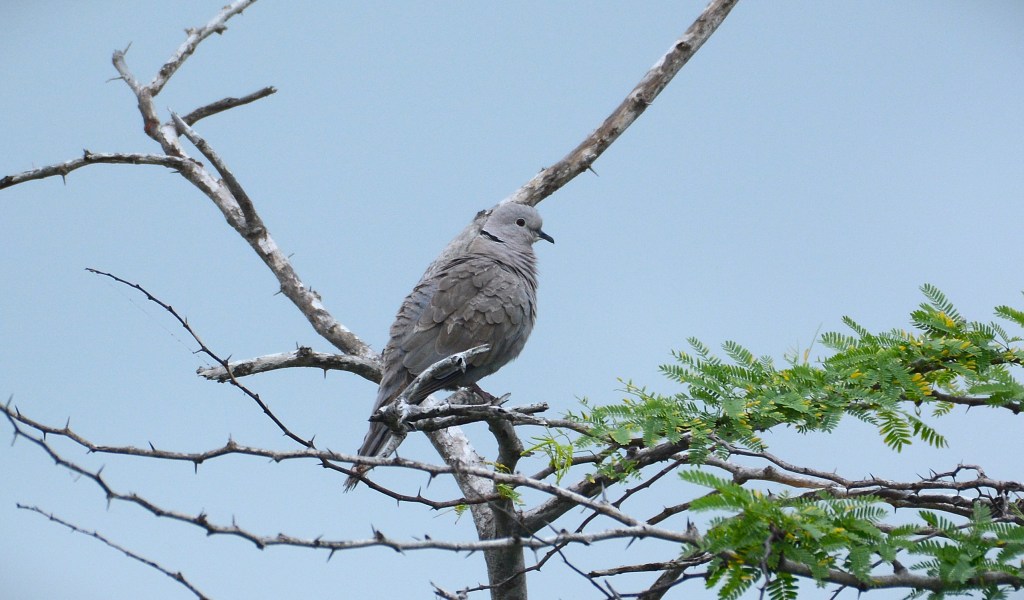
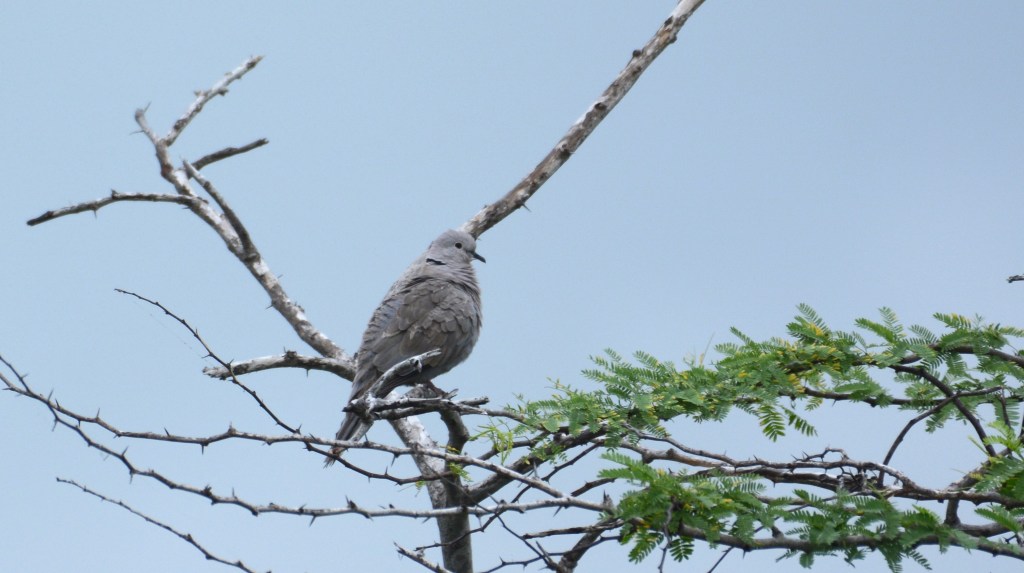
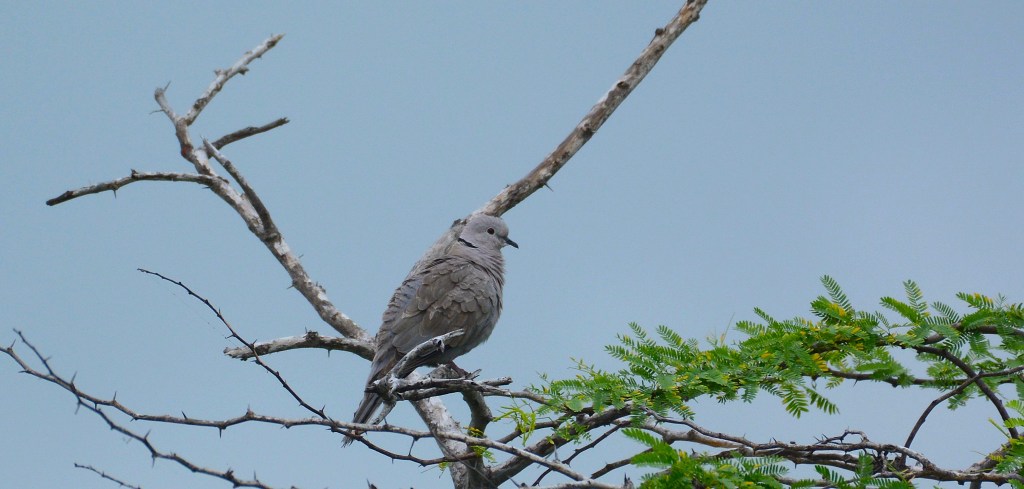
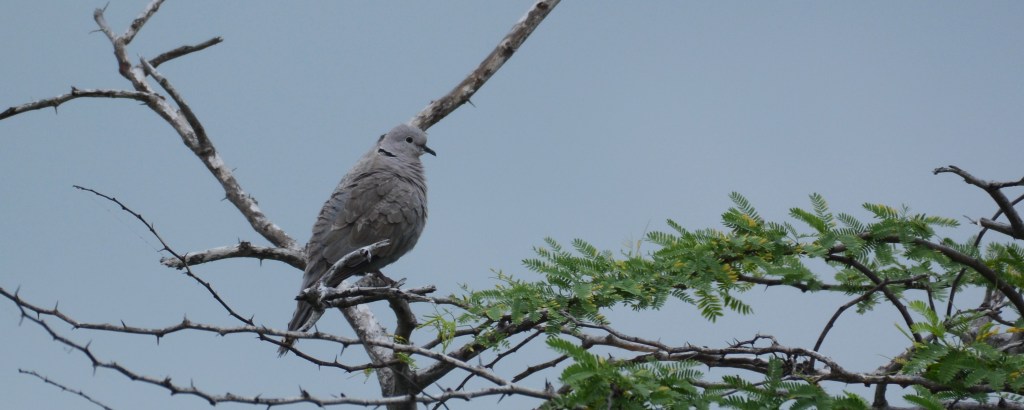
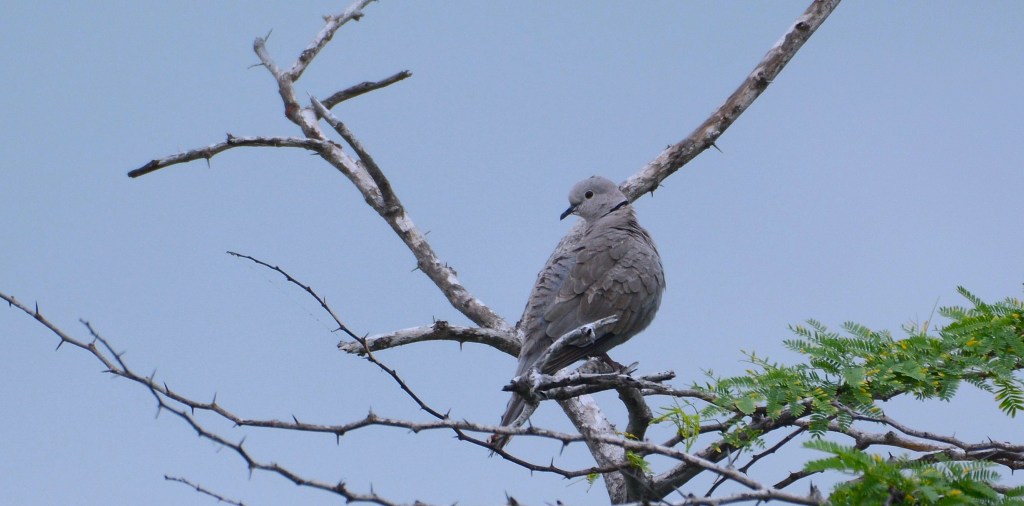
Scientific Name: Streptopelia decaocto
IUCN Status: Least Concern
A dove with a medium-built body identified by a crescent on the nape that tends to stays away from forests forming pairs or small flocks in suburban lands. The range of the species of bird extends from Northern Africa to southern Eurasia but has been introduced to the neo-temperates. The Eurasian Collared Dove form a supergroup with the Sunda Collared Dove and African Collared Dove, where identification by exterior features is handicapped, but distinction can be drawn from the unique call, where the Eurasian Collared Dove’s call encapsulates a three-note cooing, known to be distinct from the rest of the doves.
The union of the terms streptos meaning “collar” and peleia stating “dove” forms the genus name of the dove species, while the etymology of the species name is derived from Greek for the number eighteen. The Eurasian Collared Dove’s dimensions are measured as 32 cm (13 in) in length, with the extent of the wings from tip to tip spanning 47–55 cm (19–22 in), and a weight of 125–240 g (4.4–8.5 oz). A grey plumage with tail feathers tipping in white forms the feathered cloak of this dispersive species. The iris burns in flaming red but can be mistaken for a demonstrative black from a distance.
The Eurasian Collared Dove is known to breed in close proximity to human civilization mostly at less than 1 km from building infrastructure, where food resources are found aplenty. The female of the species lays two eggs in a nest made of twigs while the incubation period lingers for between 14 to 18 days, with fledgling youngsters emerging after 15 to 19 days. The male tantalizes the female of the species with a mating ritual of flight, drawing similarities to most pigeons, where it climbs rapidly to a higher altitude in a vertical line, before gliding down in circles at a slower velocity, the wings arranged in an inverted V shape.
There are two subspecies to this widely scattered avifaunal species, with S. d. intercedens being the candidate species for Sri Lanka and India. In the Americas, the Eurasian Collared Dove is known to be invasive.
Source: iNaturalist and eBird
 Perched Poems: Avifauna in Sri Lanka